


Product Center

LW720x2800-N Horizontal spiral unloading sedimentation centrifuge (matt type)
Products
Horizontal screw settling centrifuge
- Product Description
-
- Commodity name: LW720x2800-N Horizontal spiral unloading sedimentation centrifuge (matt type)
- Commodity ID: LW720x2800-N
The horizontal spiral unloading sedimentation centrifuge consists of a drum assembly, a screw conveyor assembly, a transmission component and a machine base, a machine casing, a feed pipe, an electrical control system, etc.
♦ Brief description of centrifuge structure
The horizontal spiral unloading sedimentation centrifuge consists of a drum assembly, a screw conveyor assembly, a transmission component and a machine base, a machine casing, a feed pipe, an electrical control system, etc.
•Rotating drum assembly: Consists of a rotating drum, a left end cover of the rotating drum, a right end cover of the rotating drum, an overflow plate, stiffeners, etc. The rotating drum is a conical cylindrical body, with both ends connected by the left and right shafts of the rotating drum, concentrically installed on the left and right bearing seats of the rotating drum, and fixed to the base. The spiral conveyor is concentrically installed with the rotating drum through two sliding bearings; the output shaft of the differential transmits through a spline shaft and connects to the spline sleeve of the spiral pusher, and the outer casing connects to the rotating drum through a connecting flange. By adjusting the speed of the input shaft of the differential, different differential speeds can be obtained.
•Spiral conveyor assembly: Consists of a cylindrical body segment, a material accelerator, a baffle plate, a welded spiral blade assembly, and a hollow shaft, an inner spline sleeve, and a spline shaft, etc. The spiral blades are evenly welded onto the cylindrical body, and the surface of the blades is spray-welded or inlaid with cemented carbide to increase the wear resistance and service life of the spiral; the conical section of the spiral cylinder is provided with an inlet hole, and the material enters the rotating drum through the inlet hole.
•Transmission components: Both the main and auxiliary motors use variable frequency speed regulation. The rotating drum speed and differential speed can be adjusted according to the changes in the flow rate of the suspension and the solid content of the suspension to obtain the most ideal separation effect. The differential is an involute planetary gear differential, which consists of two-stage planetary gear transmission.
•Base part: It is the supporting component of the entire centrifuge, which is assembled and welded from carbon steel parts. Left and right bearing seats are installed at both ends of the base. Disc-type rubber shock absorbers are installed at the bottom of the base, which play a vibration damping role.
•Casing part: Mainly plays the role of clarified liquid and sediment collection and discharge, and also plays a safety protection role.
•Electrical control part: The electrical control cabinet adopts a front and rear door opening form, and contains a variable frequency drive, a PLC programmer, and other electrical components. The front door is equipped with buttons, indicator lights, voltage and current display meters, and a text display touch screen, etc. The electrical control system has an overload protection function, that is, it uses the overload and overheat protection function of the variable frequency drive to automatically alarm or automatically trip, timely disconnect the motor power supply and the inlet valve power switch, automatically shut down and stop feeding.
 Horizontal spiral unloading sedimentation centrifuge structure diagram
♦ Main performance characteristics of the centrifuge
•This type of centrifuge has advanced, reliable, safe, and efficient technical performance. The centrifuge (including the mechanical body and the electrical control system) can operate safely and reliably in the acid-base suspension separation environment, has a long service life, and is easy to maintain. The service life of the main unit and the rotating drum is not less than 8 years.
•This type of centrifuge has high speed, high separation factor, continuous operation, large single-machine processing capacity, good separation effect, high clarity of the separated liquid, and low water content of the sediment;
•This type of centrifuge has small vibration, low noise, and strong load-bearing capacity. The bearings of this type of centrifuge are all SKF bearings, which have high precision and strong load-bearing capacity;
•The entire operation process of this type of centrifuge is carried out in a closed state, without environmental pollution;
•The rotating drum and spiral conveyor of this type of centrifuge adopt dual-motor independent drive, and are respectively equipped with variable frequency speed regulation. The rotating drum speed and differential speed can be adjusted according to the changes in the flow rate of the suspension and the solid content of the suspension to obtain the most ideal separation effect.
•The electrical control system is advanced and reliable. The electrical control system uses well-known domestic brand components. The electrical control cabinet includes the start and stop of the main and auxiliary motors, and the protection of the main and auxiliary motors. The electrical control cabinet includes: main and auxiliary variable frequency drives, relays, AC contactors, control cabinet body, panel operation switches, etc. The electrical control operation is convenient, the functions are complete, and the performance is reliable. A field operation button box can be configured according to user needs to achieve remote isolation and protection between the main control cabinet and the field.
•The main components (rotating drum and spiral pusher, etc.) of this type of centrifuge are precisely processed, and the whole machine is subjected to precise dynamic balance of the dual rotor (rotating drum and spiral pusher), and then the whole machine dynamic balance is performed. Through multiple dynamic balancing, the running accuracy of the centrifuge is ensured, and the stability under high-speed rotation is guaranteed.
•The differential speed system of this type of centrifuge has reliable performance. The differential of this type of centrifuge adopts a planetary gear differential, which has high differential system precision, good performance, large load-bearing capacity, reliable operation, and long service life.
•The key parts of this type of centrifuge are corrosion-resistant and wear-resistant. Key parts such as the spiral pushing surface, the spiral body material distribution part, and the rotating drum slag discharge port are generally generally hard alloy wear-resistant layers are welded. The wear-resistant layer and wear-resistant sleeve are corrosion-resistant, wear-resistant, and have a long service life. The service life of the wear-resistant layer is generally more than 3 years.
♦ Centrifuge overview and application scope
The horizontal spiral discharging sedimentation centrifuge is an automatic continuous sedimentation separation centrifuge. It is mainly used in the dehydration, concentration, clarification, and solid particle classification processes of materials with density differences. This type of centrifuge has significant characteristics such as strong adaptability to material separation, large processing capacity, continuous operation, simple operation, low operating cost, and small footprint. This centrifuge is suitable for the separation of suspensions with a volume concentration ≤20%, a solid phase density greater than the liquid phase density, a smaller solid phase particle size, and fluidity. It is widely used in many fields with density difference material separation, such as petroleum, chemical industry, food, papermaking, brewing, and environmental protection.
♦ Centrifuge functional principle
Working principle (see structural principle diagram): The suspension continuously enters the inner cavity of the spiral conveyor, is accelerated by the acceleration cone, flows out from the cloth outlet, flows into the working chamber of the rotating drum, and under the action of centrifugal force, the heavy phase material (solid phase particles) constituting the suspension quickly deposits on the inner wall of the rotating drum, forming a sediment layer, while the light phase material (liquid phase material) adheres to the inner surface of the heavy phase sediment layer, forming a clarified liquid, and a dividing interface is formed between the light and heavy phase materials. As the heavy phase sediment layer thickens, the tip of the spiral conveyor blade enters the sediment layer. Due to the high-speed rotation of the rotating drum and the spiral conveyor in the same direction, there is a certain differential speed, which causes the heavy phase sediment to continuously move towards the discharge port at the small end of the rotating drum under the action of the spiral blade and discharge from the rotating drum, and is discharged from the discharge port to the outside of the machine. The light phase liquid flows towards the overflow port at the large end of the rotating drum through the spiral channel, flows out of the rotating drum, and is discharged from the liquid discharge port to the outside of the machine, thus achieving continuous solid-liquid separation.
 Horizontal spiral unloading sedimentation centrifuge structural principle diagram
 Structural section of horizontal spiral unloading sedimentation centrifuge♦ Typical centrifuge structure
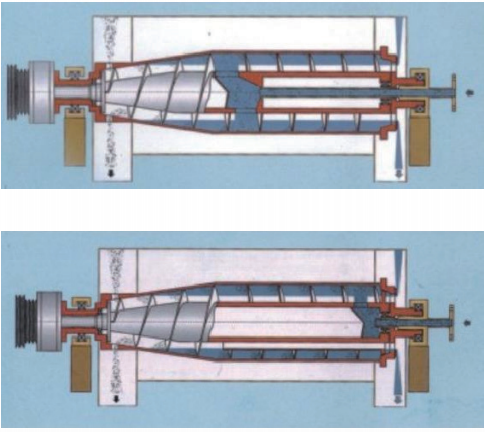
• Counter-current type: After the mixed liquid enters the rotating drum, the clarified liquid and the sediment move in opposite directions during separation and flow to their respective outlets. The counter-current type is the standard model and is suitable for most separation occasions.
• Co-current type: After the mixed liquid enters the rotating drum, the clarified liquid and the sediment move in the same direction during separation, and after separation, the clarified liquid is discharged through the reflux pipe to avoid the scouring of the sediment by the slurry during feeding. The co-current type structure is more suitable for the separation of low-concentration, difficult-to-separate materials.♦ Application conditions and adaptability adjustment of centrifuge
• Basic application conditions of horizontal spiral discharging sedimentation centrifuge:
►The material to be separated is a suspension or solid-liquid mixture, not an emulsion;
►There must be a certain density difference between the phases constituting the suspension or mixture;
►Suspension concentration 1-30%;
►Solid particle size 0.005-10mm;
►Process temperature ≤80℃
►Appropriate viscosity;
►Separation purposes: solid-liquid separation, three-phase separation, particle size grading, liquid phase clarification separation.
• Different separated materials have different separation characteristics. Even for the same separated material, different process methods and operating conditions also have different separation characteristics. The quality of the separation characteristics of the separated material will directly affect the separation effect and processing capacity of the centrifuge. The sedimentation rate is a very important indicator for measuring the characteristics of the separated material, and plays a decisive role in sedimentation separation. The sedimentation rate mainly depends on the size of the solid particles, the shape of the particles, the density difference between the solid and liquid, and their viscosity. The sedimentation rate can be adjusted and improved through the following measures:
►Adjust the operating temperature to improve the viscosity and increase the density difference between the liquid and solid phases;
►Add flocculants to increase the size of solid particles and change the shape of solid particles.
• For some difficult-to-separate materials, in addition to taking corresponding adjustment measures for the separated materials themselves, corresponding adjustments and improvements can also be made to the centrifuge:
►Increase the length-diameter ratio
►Adjust the drum speed
►Adjust the differential speed between the drum and the unloading screw
►Adjust the overflow radius of the liquid outlet
►Adjust the number of spiral heads and the spiral pitch of the unloading screw
►Add BD plate structure
• For the adjustment of centrifuge technical parameters and the improvement of related parts, except for the drum speed, differential speed, and overflow radius of the liquid outlet, which can be adjusted in a small range at the separation site, the rest must be adjusted and designed before the centrifuge product is manufactured. In addition, different materials with different corrosion resistance must be matched. Therefore, when customers inquire, please provide detailed information on the characteristic parameters, operating conditions, and separation requirements of the separated materials.♦ Typical separated materials of centrifuge
Solid-liquid separation Sludge dewatering Particle size grading Liquid phase clarification Polyvinyl chloride resin Power plant sludge Titanium dioxide Soybean protein Ammonium sulfite Dyeing sludge Kaolin Peanut protein Barium carbonate Papermaking sludge Starch Juice Strontium sulfate Natural gas desulfurization sludge Drilling mud Beverage Lithopone Calcium carbide sludge Coal powder flotation Vegetable oil Mica flakes Fiberboard sludge Quartz flotation Citric acid Shellac flakes Drilling mud Diatomaceous earth Waste oil purification Starch Ammonium di-mud Gypsum Wastewater purification Stillage waste liquid Car wash sludge Bauxite Ammonium di-mud Animal fat Activated sludge Kaolin Alum sludge Blood meal Gypsum slurry Graphite emulsion The various separated materials listed in the table are only some of the uses of this type of centrifuge. With the continuous development of various industries in the national economy, its application breadth and depth will continue to expand, and various new uses will continue to increase. For specific separated materials, suitable horizontal spiral discharging sedimentation centrifuge type, specifications and technical parameters must be selected through experiments or analogy analysis.
♦ Separation effect of centrifuge in various wastewater and sludge treatment
Name Feed moisture content Removal rate Mud moisture content Name Feed moisture content Removal rate Mud moisture content White mud 95% 90% 62% Herbivore dung 94% 90% 50% Starch 92% 95% 62% MSG 95% 90% 80-85% Soap factory clay 95% 88% 60% Steel plant sludge 70-89% 85% 35% Electroplating plant sludge 97% 90% 80% Dye factory sludge 95% 80% 80% Stillage 93% 90% 70% Titanium dioxide 90% 95% 52% Beer 95% 85% 80% Yellow phosphorus 97% 80% 70% Steel plant wastewater 96% 85% 75% Leather making 95% 90% 70% Wool washing wastewater 93% 85% 75% Papermaking black liquor 97% 70% 80% Printing and dyeing wastewater 96% 70% 80% Municipal wastewater 96% 92% 84% Mine flotation 96% 85% 70% Paper pulp 95% 95% 56-60% ♦ Main technical parameters, materials and main configurations of centrifuge (Table 1)
Parameter name/model LW245×735-N LW380×1140-N LW450×1350-N LW245×98-N LW380×1520-N LW450×1800-N Treatment of suspended liquid flow rate m 3/h 0.5-3 2-8 3-15 Changes with process conditions Solid content in suspension % ≤20 (volume ratio) ≤20 (volume ratio) ≤20 (volume ratio) Density difference between liquid/solid phases in suspension ≥0.05 ≥0.05 ≥0.05 Liquid inlet pressure MPa 0.2 0.2 0.2 Suspension viscosity CP ≤1.5 ≤1.5 ≤1.5 Operating temperature≤80℃ ≤80℃ ≤80℃ Drum type Cylindrical-conical Cylindrical-conical Cylindrical-conical Drum diameter × drum length mm245×735 380×1140450×1350245×980 380×1520450×1800Maximum rotational speed of drum r/min5000 3500 3200 Differential speed between drum and spiral8-25 stepless adjustable5-40 stepless adjustable15-30 stepless adjustableMaximum separation factor3430 2607 2580 Drum length-diameter ratio3 3 3 4 4 4 Main motor power kw7.5-11 22-30 30-37 Auxiliary motor power kw3 7.5-11 11-15 Differential typeInvolute planetary gear differentialSpiral conveyor typeSingle head/left-hand/lagging (standard)Main motor controlUses a frequency converter for speed regulation, stepless speed regulationAuxiliary motor controlUses a frequency converter for speed regulation, stepless speed regulationCentrifuge mass kg900 2400 3200 1000 2800 3800 Overall dimensions (length × width × height) mm1653×1200×7152400×1570×8592580×1910×9801898×1200×7152745×1570×8593234×1910×980Electrical Control Configuration (Standard Configuration)Inverter: Shenzhen INVT; Electrical Components: CHINT; Touch Screen: Kunlun Tongtai or Weinview.AttachmentsIncludes integral base and vibration dampers, nuts, and washers.MaterialThe drum, spiral conveyor, feed pipe, outer casing, and other parts in contact with materials can be made of 304, 321, 316 stainless steel, or 2205, 2507 duplex stainless steel, or Ta2 titanium; Left and right bearing housings: ZC45; Differential: 40CrMo; Machine base: 0235-A ♦ Centrifuge Main Technical Parameters, Materials, and Main Configurations (Table 2)
Parameter name/model LW520×1560-N LW650×1950-N LW720×2160-N LW520×2080-N LW650×2400-N LW720×2880-N Treatment of suspended liquid flow rate m 3/h 10-30 15-40 20-50 Changes with process conditions Solid content in suspension % ≤20 (volume ratio) ≤20 (volume ratio) ≤20 (volume ratio) Density difference between liquid/solid phases in suspension ≥0.05 ≥0.05 ≥0.05 Liquid inlet pressure MPa 0.2 0.2 0.2 Suspension viscosity CP ≤1.5 ≤1.5 ≤1.5 Operating temperature≤80℃ ≤80℃ ≤80℃ Drum type Cylindrical-conical Cylindrical-conical Cylindrical-conical Drum diameter × drum length mm520×1560 650×1950720×2160520×2080 650×2400720×2880Maximum rotational speed of drum r/min3000 2500 2000 Differential speed between drum and spiral10-35 infinitely adjustable10-35 infinitely adjustable15-30 stepless adjustableMaximum separation factor2620 2275 1613 Drum length-diameter ratio3 3 3 4 3.7 4 Main motor power kw37-45 55-90 90-110 Auxiliary motor power kw15-18.5 18.5-22 22-30 Differential typeInvolute planetary gear differentialSpiral conveyor typeSingle head/left-hand/lagging (standard)Main motor controlUses a frequency converter for speed regulation, stepless speed regulationAuxiliary motor controlUses a frequency converter for speed regulation, stepless speed regulationCentrifuge mass kg5700 8600 10000 6500 9500 10000 Overall dimensions (length × width × height) mm4062×1248×14294450×2280×1500 4800×2720×17804537×1248×14294900×2280×15005560×2720×1780Electrical Control Configuration (Standard Configuration)Inverter: Shenzhen INVT; Electrical Components: CHINT; Touch Screen: Kunlun Tongtai or Weinview.AttachmentsIncludes integral base and vibration dampers, nuts, and washers.MaterialThe drum, spiral conveyor, feed pipe, outer casing, and other parts in contact with materials can be made of 304, 321, 316 stainless steel, or 2205, 2507 duplex stainless steel, or Ta2 titanium; Left and right bearing housings: ZC45; Differential: 40CrMo; Machine base: 0235-A
Next Page
Product Message
Contact our team promptly; we are happy to help.
*Note: Please be sure to fill in the information accurately and keep the communication open. We will contact you as soon as possible.